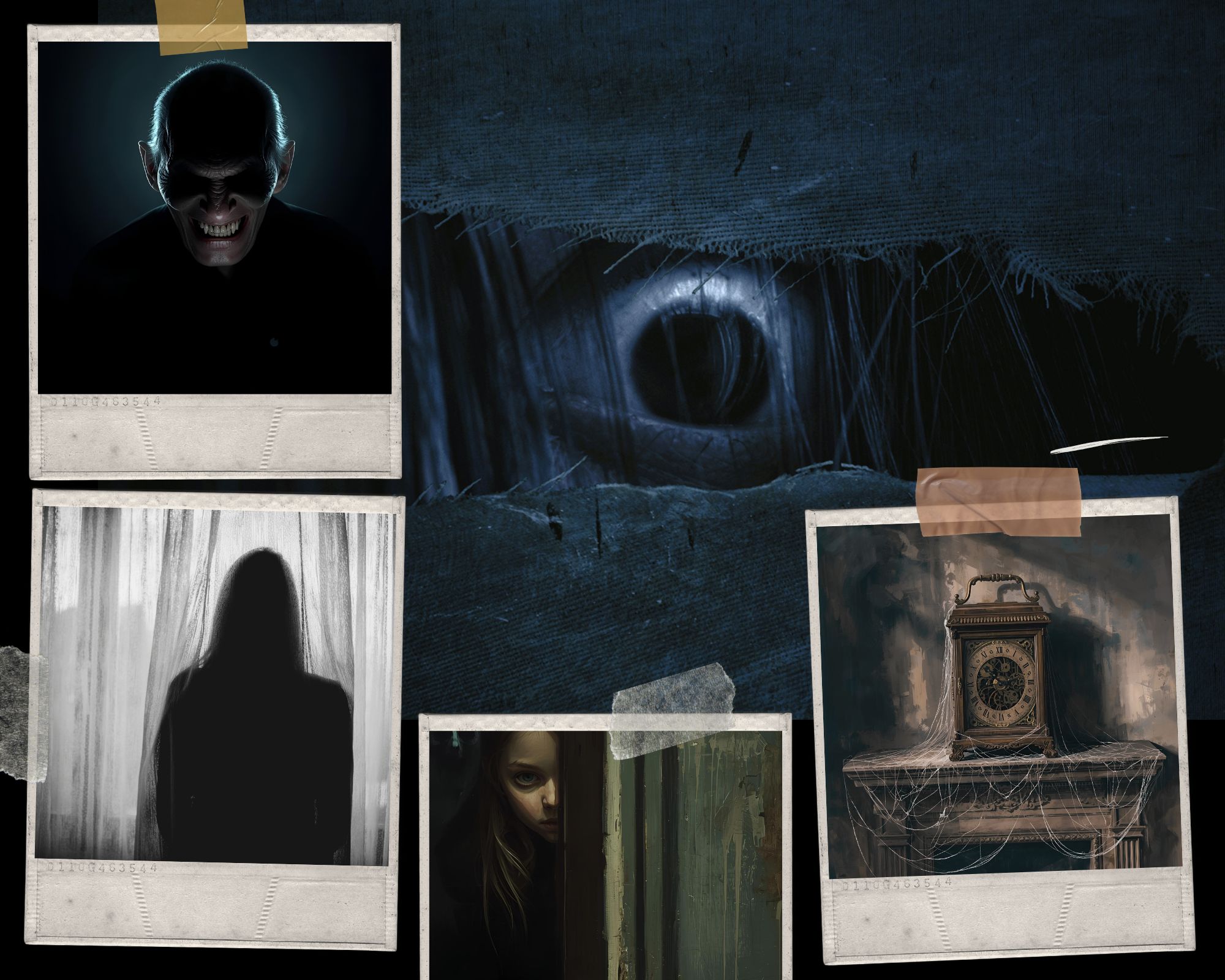
Some stories don’t end when the last page is turned, they leave fragments. Not scenes exactly. Not even memories in the usual sense. More like impressions. Images that don’t belong to a single chapter but feel inseparable from the story in its entirety. A face half-seen. A room you don’t remember entering. A sense that something’s been watching from just outside the frame.
This is what Cribbins left behind for me.
I didn’t assemble the images while writing the novel. They surfaced afterwards, once the story had settled.
A grinning obscured face.
A figure framed by curtains, representing more absence than presence.
A clock that keeps time long after it should have stopped mattering.
A child’s face half-hidden, waiting to be noticed – or not.
Cribbins is a story about intrusion. About what happens when something old finds a way back in. And most of all, it’s about the domestic setting becoming unsafe. This memory board isn’t meant to explain all of that, however. It’s closer to the residue left on the walls after something unpleasant has passed through.
I’m sharing it now because distance has a way of sharpening things. Time strips stories of their noise and leaves behind what mattered most. And what remains, in this case, is not plot or explanation, but atmosphere.
If you’ve read Cribbins, you may recognise these visual fragments like flashbacks of an old nightmare.
If you haven’t, consider this a warning: Some stories don’t ask to be remembered. They insist.
 R. H. DIXON